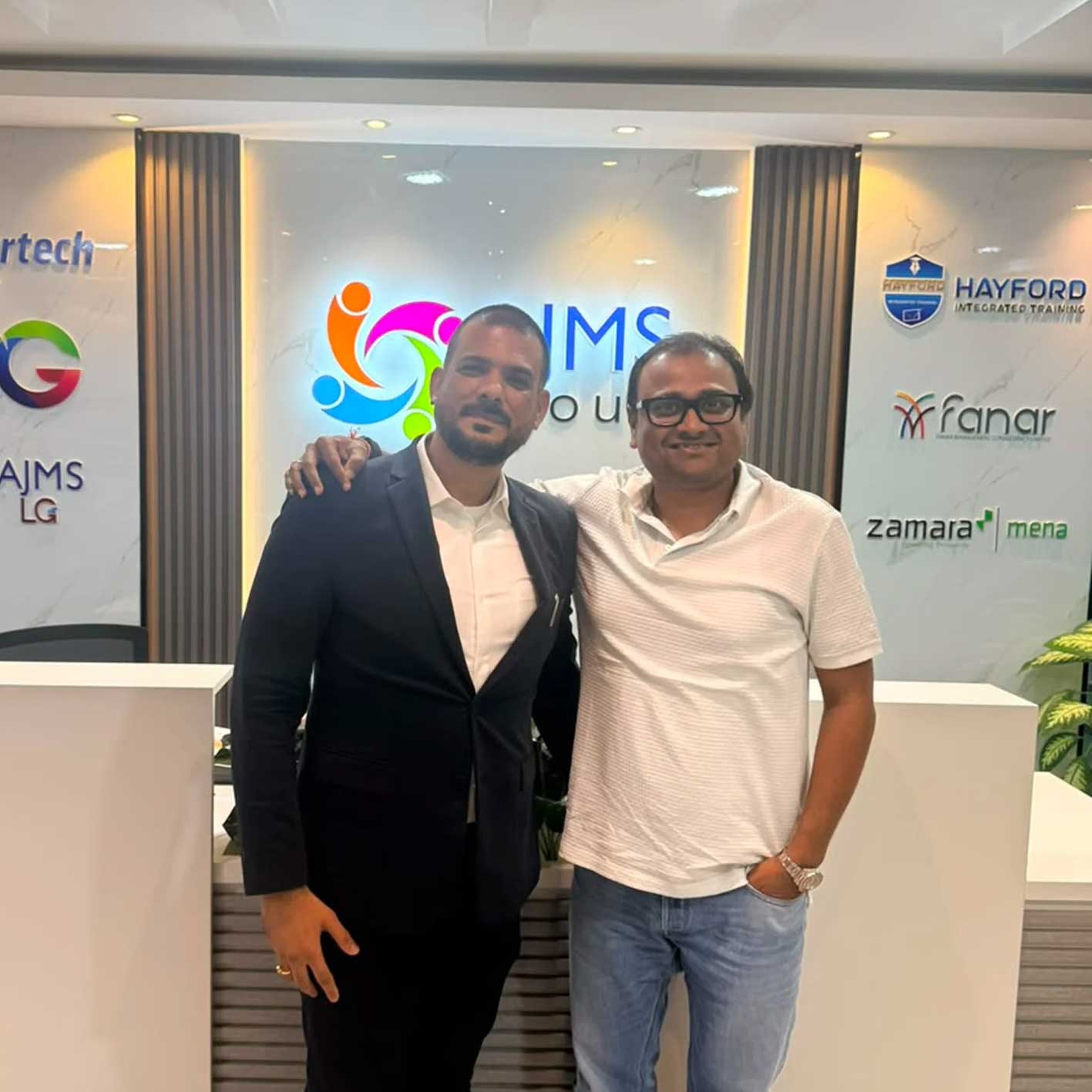

Built, Not Born: The Dr. Abhishek Jajoo Story
There is a moment in every founder’s story when the ground shifts — not with fireworks, but quietly, the way a seed shifts underground long before anyone sees the shoot. For Dr. Abhishek Jajoo, the ground had been shifting for three generations before he was born.
His is, at its heart, an Indian story: migration, enterprise, and the slow, unglamorous accumulation of trust — a story repeated a million times across the subcontinent, and lived out in full by the men who came before him. To understand the ecosystem he commands today — hundreds of professionals, a family of companies, offices scattered across the Gulf and beyond — you have to begin where he does: with a boy, a tailor, and a ten-rupee note.
A Family Forged in Migration
Abhishek’s grandfather made his way to Kolkata in 1965. His father followed in 1976 — and started working at sixteen, refusing, even then, to let earning cancel out learning. He kept studying while he sold goods for a man the family still speaks of with warmth: Gwalka ji — Sethji to everyone who knew him — who owned manufacturing units supplying goods across Orissa, Jharkhand, Madhya Pradesh, Chhattisgarh and Bengal. Sethji did not merely employ the boy. He treated him like a son.
That trust would go on to shape two families’ fortunes. As the years passed, Sethji’s own heirs proved unable to run what he had built, and in 1998 he made an extraordinary offer: he asked Abhishek’s father to take charge of all seven of his industries — operations, profits, the lot — for a fixed monthly commitment of ₹2.5 lakh. It was an act of faith only decades of demonstrated loyalty could earn, and Abhishek’s father accepted it.
But the debts kept climbing. And it was Abhishek’s father who made the harder call — to liquidate the assets, clear the debts outright, and only then step out to build something of his own. What he built spanned textiles and rubber, including a bicycle tyre-and-tube factory that, remarkably, still runs today, employing more than seventy people. The lesson beneath it — that you honour your obligations before you chase your ambitions — would outlast the factory itself.
Rich in Discipline, Not Merely in Comfort
By the time Abhishek was born in 1986, the family had climbed into a comfortable, upper-middle-class Kolkata life. But comfort, in the Jajoo household, never curdled into indulgence.
He remembers being sent as a small boy to collect stitched clothes from the tailor, a ten-rupee note pressed into his hand. When the accounting came back one rupee short, he was scolded — firmly. There was no pocket money in that house. Every rupee was accounted for; every child was taught, early and without exception, that money is not something you are owed, but something you learn to respect.
“In today’s world,” he says now, “there’s no concept of entitlement. Everything is driven by merit.” It is a conviction he has carried into the way he raises his own children.
He studied to class ten at St. Helen’s in Howrah, then moved to the storied La Martinière for Boys in Kolkata for his final two years — a name that commanded respect then as now, its fees running to ₹4,000 a month in 2000–01, a substantial sum, and a quiet marker of how far the family had travelled from a sixteen-year-old learning a trade under another man’s roof. Mathematics was his subject of choice; a B.Com from St. Xavier’s followed. And when the well-worn path of Chartered Accountancy beckoned — as it does for so many bright commerce students in India — Abhishek chose differently. He took an MS in Finance from ICFAI, then an MBA, and later a CAMS certification in anti-money-laundering — the credential that, without his fully realising it at the time, would become the seed of everything he would build.
The Recession That Redirected Everything
His graduation coincided, almost to the month, with the collapse of 2008. He was in France on an exchange programme when Lehman Brothers fell — and, in an age before news moved at today’s speed, the sheer scale of it did not register at once.
That year he was offered a pre-placement role at GE worth ₹11 lakh. Young, and by his own admission not yet grasping the gravity of the moment, he turned it down to wait for the final campus round. In any other year it would have been unremarkable. But 2008 was not any other year: the downturn was severe enough that his college imposed an unusual rule — take a single offer, and you forfeited the right to interview anywhere else.
He joined Bank of Baroda’s risk-management department in Mumbai — a twenty-three-year-old Scale 3 officer reporting to a fifty-eight-year-old Scale 2 officer. The generational and cultural gap, he says, was simply too wide. Within six months he knew it was not where he belonged.
Kuwait, and the Leap Nobody Told Him to Take
What followed was a decade that quietly assembled every piece he would eventually need. Driven by a competitive, almost restless work ethic, he left for Protiviti in Kuwait, spent a year there, returned to India to marry, and then joined Al Ahli Bank of Kuwait, where he would spend four and a half years — until September 2014 — immersed in FATCA, CRS and AML compliance for banks.
It was his boss at ABK, catching sight of his instincts, who first floated the idea: why not build something of your own? The offer came attached to a salary. Abhishek’s answer was characteristically direct — he would step in only as an equity partner, never an employee. He negotiated a 33 percent stake, structured so that his two co-founders funded the venture first, his own capital entering only once theirs was spent. It was a shrewd bet, and it paid.
FATCA and CRS compliance became his first true venture into consulting — and revealed a regulatory gap in the market that almost no one else had spotted. The firm began winning major banking clients on the strength of that single insight. By 2016, FATCA, CRS and AML had become the region’s hot topic, and his practice sat squarely at its centre — even as his family remained in Kuwait, seeing him only on weekly commutes, until he finally made the full move to the UAE that year.
“We are not a startup. We are starting up an entity.”
The early days in the Emirates were nothing like glamorous. It was the moment the UAE first opened its doors to 100 percent foreign ownership of professional licences — an opening Abhishek seized at once. But seizing it meant standing, in person, in line at the Ministry of Labour to sort out employee visas, doing the work of an office boy because there was no one else to do it.
He has since come full circle in a way almost too neat to be invented. Today he holds “Diamond” employer status under MOHRE, has been recognised as one of the country’s best employers — zero complaints, zero salary delays, ever — and leads a group of roughly 700 people. The man who once did the office boy’s job now runs a house where office boys are given the chance to become something more.
Building an Ecosystem, Not Just a Company
Ask Abhishek what he has built and he will correct you before you finish the question. “We are not a startup,” he says. “We are starting up an entity.” The distinction matters to him. He does not see himself as an investor in the Shark Tank sense — someone who writes a cheque and steps back, banking on a portfolio where one win pays for many losses. He calls himself, without hesitation, a businessman: someone who wears the hat of investor or professional as the moment demands, but who is always, fundamentally, building and running the thing itself.
What began with that first FATCA/CRS win has since scaled into something far larger — a family of companies spanning consulting, technology, healthcare and pensions, diversified across jurisdictions and bound by a single operating logic. There is DPMS, launched in 2022 and built purely around anti-money-laundering compliance and software for the gold trade, now a roughly ten-million-dirham-a-year business. There is a newer venture in Shariah-compliant pensions and insurance, structured as a fifty-fifty partnership grounded in the same currency Sethji once extended to his father: decades of trust. And there is, most tellingly for the moment the world is in, AJMS AI — the group’s applied-artificial-intelligence arm, launched in 2025, among the first firms in the region to appoint a Group Chief AI Officer. It is the clearest sign of how Abhishek thinks: where his earlier firms each turned one hard-won specialty into software, AJMS AI turns the method itself — the discipline of converting expert judgement into governed systems — into something the whole ecosystem can draw on.
He describes the whole as a platform: a place where people join and grow the business together, and where any new venture reaches break-even in around three months, because the ecosystem itself does the heavy lifting of bringing in clients. From a standing start, it has grown into an enterprise turning over close to a hundred million dirhams a year — built, remarkably, on its own internal capital. He has never diluted equity to an outside investor; only ever to the partners who stood beside him from the first day. “Partnership for life,” he calls it. His dream, stated without embarrassment, is offices in ninety countries — and the enterprise has already begun to plant them back in India, closing, quietly, the loop his grandfather opened in 1965.
None of that scale would hold together without the person he is most careful to credit. His wife, Komal Jajoo, is not a supporting character in this story but a co-founder of it — Managing Partner of the group and the architect of its human side, from its culture to Hayford, the training institute through which the enterprise builds the next generation of its own talent. Recognised in her own right as an outstanding woman entrepreneur in education, she runs the part of the business the balance sheet cannot fully capture: the people, and the standards by which they are grown.
“You can lie to anyone — but not to yourself.”
The Philosophy Beneath It All
If a single thread runs through everything Abhishek says, it is this: what he is really looking for — in himself, and in the people he builds with — is not confidence, but security. Confidence, he argues, is situational; it rises and falls with circumstance. Security runs deeper. It comes from self-awareness — from knowing your own strengths and weaknesses without flinching from either.
“You can lie to anyone,” he says, “but not to yourself.” A secure person does the harder work of self-inspection rather than hunting for someone to blame. An insecure one, however confident he may appear, grows defensive, guards his turf, and shies away from the very risks a business must take to grow. “The fundamentals of my business,” he says plainly, “are built on security.”
That philosophy shapes how he treats the people around him. He gives interest-free advances to his staff — for a first home, for a family wedding — a practice he inherited directly from watching his own father do the same for his workers. Promotion, in his firm, is a matter of merit and nerve, not tenure or title: the support staff most companies render invisible are given training, mentoring and the chance to prove themselves, and more than a few who began as drivers or office assistants now hold operational and client-facing roles. “Duaon mein jitna dum hai, woh dawa mein nahi hai,” he says — there is more power in blessings than in medicine. Hierarchy, he believes, is largely a Western import; the traditional business he grew up watching ran instead on trust. And he insists, more than once, that you cannot appease everybody, and should never try.
The same directness governs how he wants his own children raised. Just as his mother once refused to let him settle for inheriting a factory — dreaming for him a life among decision-makers and policy-shapers, not merely spreadsheets — Abhishek is determined to let his children dream their own dreams and build outside the shadow of what he has already built. None of it, he is quick to add, would have been possible without the women who backed him at every turn: his mother’s vision for him, and his wife’s unwavering faith in the risks he chose to take.
“There is more power in blessings than in medicine.”
Coming Full Circle
Somewhere in the middle of it all — building an enterprise across the Gulf, sponsoring a Paralympic athlete who competed in Paris, being recognised at the highest levels of the UAE government — Abhishek noticed that something had slipped quietly through the cracks: his own health.
True to form, once he decided to act, he committed fully. Around his birthday on the tenth of July he began a deliberate health journey — chasing not how he looked, he is careful to say, but how he felt. Seven to eight hours of sleep, non-negotiable. Full-body strength training with a trainer. And after every workout, a shower and then his home temple — a quiet, unbroken ritual of prayer he learned simply by watching his father, and that his own sons are now learning simply by watching him.
That, in the end, is the lesson running beneath all of it. The things worth building — a business, a family, a life — are rarely taught in words. They are built, quietly, by watching someone do the work. Abhishek Jajoo was not born into what he commands today. He watched it being made, then made it again — and is, even now, being watched in turn.