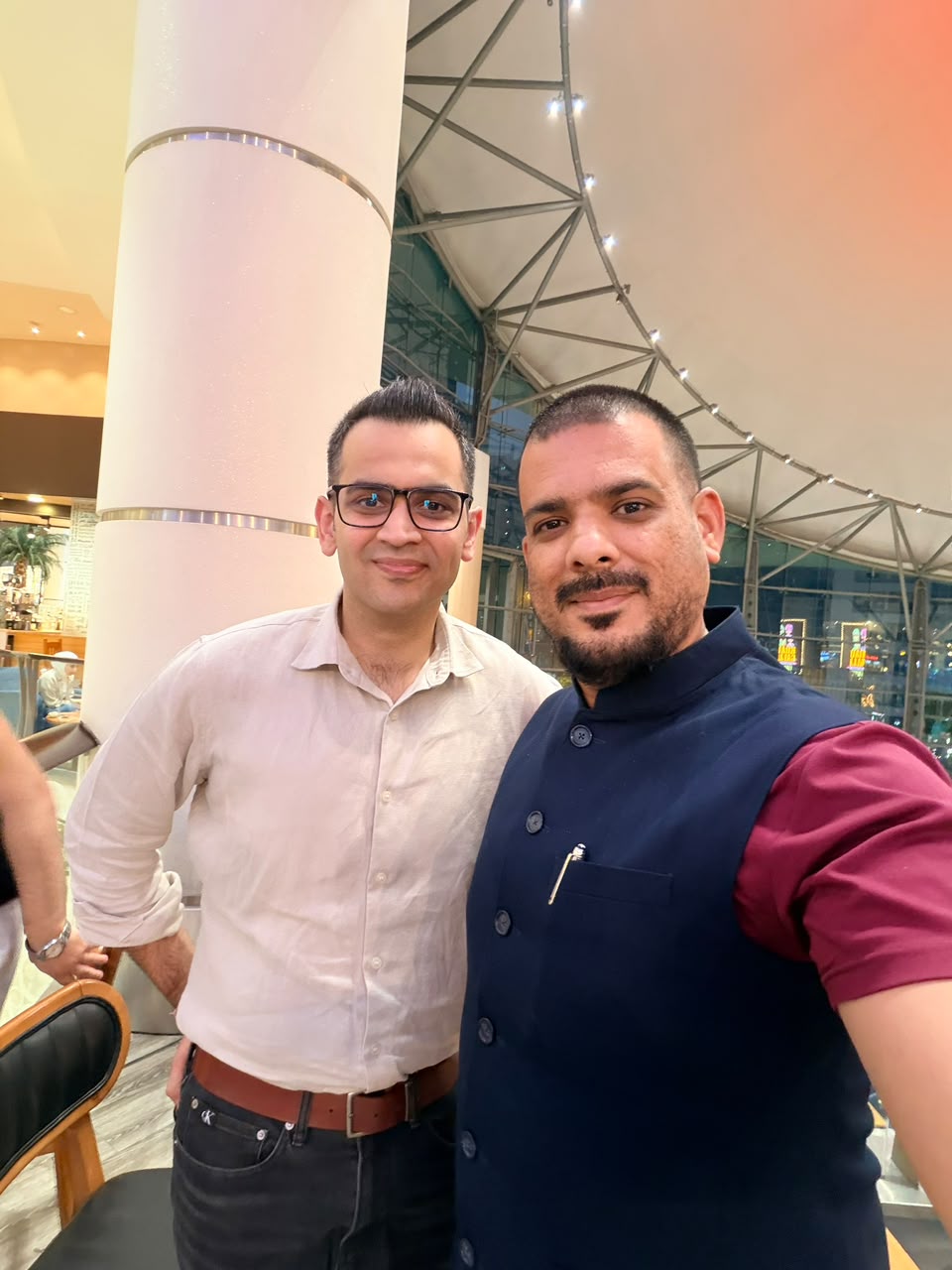

A BUILT, NOT BORN FEATURE
Built, Not Born: The Son Who Wasn’t Handed the Keys
From a one-room studio in Naif, where every dirham was counted, to co-founding an e-invoicing venture built in-house for the UAE’s new regime, Tushar Gupta could have taken the easy road at every turn. He kept choosing the harder one — and learned, through a hundred-thousand-dollar failure, the difference between being given a chance and earning a place.
THE TUSHAR GUPTA STORY
There is a particular kind of burden that comes with having a father who succeeded. From the outside it looks like a head start. From the inside, it can feel like a question you are never allowed to stop answering: would you have got here on your own?
Tushar Gupta has spent most of his adult life answering it. He walked out of two universities, took the only articleship offer he received, walked away from one of the world’s most sought-after hedge funds with a promotion waiting if he came back, and then lost a hundred thousand dollars of his father’s money on his first product. None of it looks like a straight line. All of it, he now believes, was the road.
To understand why, you have to begin where the money ran out — before he was even born.
A Studio in Naif
Tushar’s father, Pawan Kumar, qualified as a Chartered Accountant and went into stock broking with a partner. Then came 1992, and the Harshad Mehta scam. The losses were heavy. The business collapsed, the creditors came, and a newly married young CA found himself without work and with debts to repay.
A close friend referred him to a job in Dubai. In January 1994 he made the move — not to chase a dream, but to sustain a family and clear what was owed back home. Tushar was born in Delhi in 1996, and a year later the family joined his father in Dubai.
Home was a studio apartment in Naif, in old Deira. His mother came from a family that had once been prominent — her grandfather had been a politician — before losses wiped everything out. She had a diploma in computers, and she had married an educated man because education was the one thing that could not be taken away. On weekends, his father also did accounting work for local shops to supplement his father’s salary and send money home against the debts.
“At that time, we did not have the means to even buy a Pepsi can.”
The family travelled by public transport. Vegetables came from the wholesale market in bulk, five kilos at a time, frozen so they would last. Every dirham had a place. And yet, Tushar says, there was no sense of complaint. When you have never seen anything else, scarcity is simply what normal looks like.
Ten Dirhams a Month
He studied at Indian High School — chosen, he says plainly, because it was the most affordable school near home. His mother had one conviction: education was the route to rising in life. Every day she sat with her sons and went through what had happened at school and what needed doing next. Without anyone naming it, a habit was being built.
There was no pocket money until Grade Five. Then he was given ten dirhams — for the whole month — so that he would learn how to make decisions with money. He saved every one of them.
In Grade Six, he topped his school and was awarded a scholarship of 300 dirhams, handed to him as a cheque. “I suddenly felt very rich,” he laughs. He spent it on gifts for his father, his mother and his brother.
The memory that stayed with him longest, though, is not the cheque. It is the birthday invitations. Classmates from more privileged homes celebrated at McDonald’s — a dozen friends, a cake, games, a clown, a magic show. Tushar knew, without ever asking, that such a party was not possible for him. He didn’t resent it. He turned it into fuel. Kuch toh karna padega — something needs to be done.
Family outings were rare and treasured. Once a year there was dinner at the Marco Polo Hotel, where qawwali singers performed live. More often it was dal and Arabic bread at a modest Pakistani restaurant nearby, and on Saturdays, a rented movie watched by all four of them together.
When teachers went around the class asking what each child’s father did, Tushar had a simple script: my father works in a CA firm. His parents had asked him to keep it modest. Looking back, he believes it was their way of protecting him — from assumptions, from comparison, and from the questions that come when people think you are richer than you are.
The Man in the Shade at Camel Park
The story Tushar tells most carefully is not his own. It is his father’s.
In 2001, the firm his father worked for laid him off due to a lack of business, leaving him out of a job. He told no one. Every morning he dressed in his office clothes, picked up his packed lunch and left home as usual. He spent the day hunting for work, and at lunchtime he sat in the shade at Camel Park, near the Dubai abra, to eat. For fifteen or twenty days, the family believed he was going to the office.
He absorbed the stress himself so that none of it reached home. Only once he had found a new job did he tell his wife what had happened.
That quiet grace would come to define him. In 2006 he began building something of his own — working his regular job from nine to six, then working on his own initiative from six until midnight. The idea was a software product. For twelve to fourteen months he built it, then showed it to a prospective client for review. The verdict was blunt: there was nothing in it.
He did not take it personally. He took the feedback, went back and started again from scratch. Nothing is wasted, Tushar reflects — his father had learned how to manage his time, how to speak to product people, how to speak to clients. Fourteen months later, he launched again. Suntech Business Solutions
FZCO’s trade licence is dated October 2007, and in 2008 — in the middle of the global financial crisis — the first customer signed on.
The real turning point came in 2009 and 2010, when one of the region’s large jewellery groups came on board. Tushar, then around fourteen, could feel the difference at home. If something fell and broke, there was no longer a sharp voice about it. His parents had begun, finally, to relax.
The family moved to a home with a gym, a swimming pool and sports facilities. In 2012, his father sent both sons on their first school trip abroad. But the habit of counting had set deep. Even as life got easier, every decision to spend still carried the weight of old memories — and a good deal of guilt.
The Double Dropout
By the end of school, Tushar had built an identity around one thing: he was the boy who performed. He wanted to study economics, and for the first time he let himself consider a university abroad. He applied to Delhi University and to colleges in the UK.
He got into Hansraj College in DU’s North Campus — and could not relate to it. So he went to Warwick, one of Britain’s most respected universities for economics. The total cost over three years would run to roughly ₹1 crore. His parents could afford it now, and they told him so. But he could see the calculation still running behind their eyes — a visible tension, but a comfortable tension.
The question would not leave him: was what he was learning worth that money? After paying for the first semester — losing ₹10 lakhs — he decided it was not. He dropped out — for the second time — and came home with no plan at all.
His parents did not argue. His mother was simply happy he was coming home. His father’s only response was: if this is the career you want, don’t think about the money — stay. Tushar came back anyway.
What he had understood about himself was that he learned best alone. A self-study course suited him. Chartered Accountancy cost around ₹10,000, and his father was a CA — so, in the practical logic of a teenager, that settled it.
Today he is honest about the hindsight. College is not only lectures; it is a community and a network, and there are days he wishes he had one. Those were maturity gaps, he says, without regret. The decision had been made the only way he knew how to make decisions then — with the price tag in full view.
Fifty Rupees for an Apple
He cleared CA Intermediate with a rank in the sixties nationally, and his institute wrote to tell him he was among the top hundred. He could have used his father’s contacts to find an articleship. He refused. I wanted to develop my own identity, he says.
He applied to all the Big Four firms through their online portals. Only one responded. KPMG put him through an aptitude test, a group discussion and interviews — and made him an offer. It was the only one he had. He did not get so much as an interview anywhere else.
His stipend was ₹15,000 a month, among the highest of any firm, and he felt empowered. Then he went to buy fruit on his own in Delhi for the first time, and discovered that a single apple cost fifty rupees. He stopped eating apples. He took the metro everywhere. He knew his family was comfortable back home. He simply wanted to know whether he could manage without them.
KPMG also taught him what kind of workplace he never wanted to build. In his third year, he applied well in advance for two days’ leave to attend a cousin sister’s wedding in April — the heart of audit season. A partner responded by becoming abusive. If the policy asks for thirty days’ notice and I’ve given it, what was the need? It was the first time he told himself that he could not survive in an organisation like that.
Breakfast at the Leela
He cleared his CA finals in his first attempt in 2018. Finance was his love — he scored 76 in the paper, well above his other subjects — and like every new CA, he put his CV on the job portals.
An invitation arrived from the D. E. Shaw group: come for an interview, with breakfast at the Leela. He admits, grinning, that he went mostly for the free breakfast. Four rounds of interviews later, he had an offer — and a salary he had not expected, from one of the best paymasters in the industry. He moved to Hyderabad.
For the first time he was entirely on his own: finding accommodation, working out what rent was reasonable, managing his food and his health. He was earning well, and slowly, the tight grip he had always kept on money began to loosen.
The moment it truly eased came on a visit home. He took his mother shopping at the DLF Mall of India in Noida and bought her the designer sarees she had chosen. When she got home, she became emotional. This was the day she had been waiting for, he says — not because someone had bought her something, but because her son had built his own life and could afford to.
“I wanted to free my relationship with money through my own identity and my own efforts first.”
- E. Shaw shaped him in other ways too. He was among the first hires in the Hyderabad team, working on trade compliance for a multi-billion-dollar hedge fund. Different investment mandates carried different rules — some clients’ money could go only into specific categories, others allowed far greater risk — and his team was responsible for setting the guardrails within which traders could operate. He reported functionally to New York, to a manager who had studied at Harvard Law School and whose own manager had come from Stanford. The firm had no single boss at the top, only an executive committee. It was a free-flowing culture, the opposite of what he had seen before.
He also started working closely with the product team, building technology for trade compliance. It was his first taste of how a product is built, tested and measured for impact — and it planted something that would not go away.
Leaving the Safe Road
Then COVID arrived, and with it a sudden realisation. Now that money no longer frightened him, earning it had stopped being a strong enough reason to stay. His career was on track — there was talk of a move to New York — but he was not being stretched.
“I need challenge,” he says simply. “Until I feel challenged, I don’t feel I’m using my skills in the best way possible.”
The pandemic’s flood of liquidity had set off a wave of startups, funding rounds and eye-watering valuations, and Tushar followed all of it. Technology fascinated him. An MBA from IIM or ISB was the obvious next step for someone with his profile, but he did not even apply. Those programmes, he felt, were built to feed corporate India. He wanted something unstructured — space to figure things out for himself, alongside people who wanted the same.
He found it in Masters’ Union, a new school in Gurugram, then only in its second batch. He won a 75% scholarship. His parents were unsure. His well-wishers were alarmed — what are you doing, you should be going to an IIM. Even his hiring managers at D. E. Shaw was concerned, and promised him that if he came back, they would take him back with the promotion he was due.
“If I were in their position, I’d probably have seen it the same way,” he concedes. “But I stood firm.”
He joined in October 2021. His classmates included a finance leader in his mid-forties, IIT graduates, founders, people from film — many of them, in his words, working through their own mid-life reckonings. He read a Java book cover to cover to understand how systems work. He watched seniors pitch a micro-drama startup off nothing but wireframes and raise four hundred thousand dollars. One of his closest friends from the programme now runs his own funded startup.
Then came an internship at BCG, and another setback: no pre-placement offer. He was, once again, without a clear next step.
A Hundred-Thousand-Dollar Lesson
In July 2022, as the programme was winding down, Tushar came to Dubai on a short trip and started dropping into his father’s office — just to see how a product company thinks. His father made him a simple offer: if you like products, come here and see whether this environment is right for you.
He took the chance. His father gave him complete autonomy and questioned none of his decisions. Tushar speaks of that trust with real admiration.
His first idea was a CRM. Suntech already built ERP systems and had a captive client base, so a CRM felt like a natural extension. Arriving from the glamour of the startup world, he was sure it would be easy. He told his father he would reach a hundred customers within three months. His father’s only feedback: that sounds very ambitious — even ten will be difficult.
Tushar went with his plan anyway. For fourteen months he tried to build it — forming a team, conceptualising, getting it developed, shipping it, testing it with clients. It was funded by his father’s first cheque: one hundred thousand dollars.
It failed. Utterly.
“Until then, everything in my life had felt like it was validating me. Wherever I put my hand, I found gold,” he says. “This failed so dramatically, I had never experienced anything like it.” He did not know how to build a business, how to put a team together, how much capital to deploy, or at what pace. He had never once sat with a real user and asked what they needed. He built what he imagined they wanted, demonstrated it, and could not understand why no one was happy.
He carried dejection, shame and anger. It was hard to admit it had failed — he admits he was not quick to see it. It was his father and his mentor who helped him see it.
His father did not blink. I’ve seen these failures happen, he told his son. Don’t treat it too personally. This learning is very important for you — take it and convert it into something else.
It is hard not to suspect that his father saw the ending from the very first conversation — and let his son walk into it anyway, because some lessons cannot be handed over. They have to be paid for.
The other voice in that period belonged to the man Tushar calls his second father, more than a mentor. What makes him a mentor, Tushar says, is simple: he will give you the advice that is right for you, and he will not sugarcoat it. He is not a validator. He plays devil’s advocate. If something is wrong, he says it is wrong.
Back to the Ground
He sat down and asked himself honestly where he had gone wrong. The answer came in three parts: he did not understand sales, he had never built a process, and he did not know how to build a team. He decided to fix them one at a time.
First, sales. For three months he went out on the ground in a suit, pitching the firm’s smaller services to businesses that had never used them — explaining VAT returns box by box, promising proper documentation, and learning that “I’ll look into it” almost never means anyone will. He worked hard at LinkedIn to reach corporate clients. What he learned there has stayed with him:
“If the person across the table feels you’ve come to sell, they switch off. If they feel you’ve genuinely come to help them, to add value, that conversation changes.”
Second, process. He realised his first venture had failed partly because he had never built a process for anything. So he found a service that needed one, designed a standard operating procedure for it, and then governed it — tracking whether it was actually followed.
Third, the team. He had believed that anyone could be picked up and the work would get done. It does not work that way, he learned: you have to understand what each person needs, what to give them, when to motivate them, and what to ask. He built a small team, hired for it himself and took accountability for it. He also moved work that was being done in Dubai to a back office in Kerala, cutting costs while building capability. His first hire there has doubled his salary in four years.
Application Number 103
When the UAE published its requirements for e-invoicing service providers, Tushar saw the opening. Suntech had already been doing e-invoicing work for clients in India and Saudi Arabia for years. Going
down the requirement list, he found the firm already had almost everything — except Peppol certification.
Other providers, including established ones, came to the office offering partnerships: plug your ERP into our platform and it will work. The firm weighed its options, but something in Tushar kept saying: no — we should build this ourselves. Through Tax Compliance Agent, the new e-invoicing company where he serves as Co-founder, they set out to build the solution in-house.
This time, he did not rush. He broke the problem into small milestones and set a decision rule for each one — if we achieve this, we keep building; if we don’t, we partner.
Then, on 17 April 2025, came a conversation at a Starbucks in Gurugram. A colleague who worked with the firm part-time introduced him to her husband, Kanishka Garg, who had come from Amazon and was interested in automating transfer-pricing work. They talked about automation, about agentic AI, about building products. Kanishka Garg had a product mindset, and they clicked. He also had a message: e-invoicing is coming to the UAE — you should explore it. Tushar’s answer: he already was.
In June 2025, Tushar filled in the form to become a Peppol member — not yet certified, simply a member, to see what it would take. Then came the question that would decide everything: would Kanishk leave his job?
The two of them talked it through in detail. What happens if this fails? What is the worst case? Where does the capital come from? They set a twelve-month Plan B: if it had not worked by then, Kanishka Garg would go back to his corporate career, and in the meantime they could fall back on smaller automation products. The funding came from within — on arm’s-length terms, to be returned, in keeping with his father’s practice of never taking outside capital. Kanishka Garg quit. They became partners.
The firm fractionally hired a developer to sit with them and understand the whole code base, and committed to building everything in-house. The first milestone was a Peppol certification that was already eighty percent within reach. Around the time of Tushar’s own wedding, they filed their application with the Ministry — application number 103. Crossing every hoop, they became the 23rd ASP to get listed, sailing through the application process ahead of many others. Every day they worked late into the night, and every day they were on calls.
The two lessons from the CRM failure had become the operating system of the new venture. First, milestone-based planning: never a random rush of activity, but a clear sense of what you are trying to prove and in what order. Second, governance — which Tushar defines, disarmingly, as simply tracking.
“When you start something, you’re over-enthusiastic. You feel you’ll do everything,” he says. “Do one thing. Put eighty percent of your attention on it and twenty percent on revising the plan — but keep your focus very sharp.”
“I don’t think I am super smart,” he adds. “I think destiny had it for me. All those experiences had prepared me for this one.”
What He Inherited
Every generation believes it is smarter than the one before. But some things pass down silently. Asked what he absorbed from his father without being told, Tushar names two.
The first is calm. Staying calm when things go badly, and not overreacting. It is the man who ate lunch alone at Camel Park so his family would not worry, and the man who watched a hundred thousand dollars disappear without blinking.
The second is integrity. He is just a genuine person, Tushar says. He is not someone who would cheat anyone — not his employees, not his partners, not anyone. Doing business with integrity matters more to his father than anything, and Tushar sees the result in how loyal Suntech’s clients and employees are.
They are not identical. Tushar is, by his own description, always pumped up; his father is calm, almost impossibly so. A big win at home earns, at most, a quiet good job. Tushar has come to see that restraint as something he will need too.
On money, he has travelled a long way from ten dirhams a month. Capital matters, he says, but it is only one of the resources a business needs. People bring energy. People bring IQ. People bring EQ. Those are resources too. His firm now funds training that staff apply for themselves. On what makes a real difference to how people grow, he points back to that first hire in Kerala.
The Philosophy Beneath It All
He calls himself a selectively extrovert. He reads more articles than books, and a lot of mathematics. He still wants mentorship — now, he says, in balancing priorities. He has just married his wife, Jahnavi Gupta, and the e-invoicing work is running at full tilt; finding the balance between the two is the thing he is still building in himself.
Asked which single quality of his own will carry him furthest, he does not reach for ambition, intelligence or risk appetite. He gives the same answer he gave about his father.
“Just being a genuine person.”
That, in the end, is the line that runs through the whole story. A father who kept his troubles to himself, repaid what he owed, and built a company without ever taking outside money. A son who could have taken the easy path at every junction and chose, again and again, to earn his own ground first — an articleship with no reference, a salary he managed himself, a failure he paid for and learned from.
Privilege can hand you a door. It cannot walk you through it. Tushar Gupta walked through his — twice out of university, once out of a hedge fund, once into a failure — before he found the one that was his.
Like every guest on this series, Tushar is, in his own way, one of my teachers — and this is his lesson, shared with the world.
Built, Not Born.
Was there a failure that taught you more than any success? Share it below. 👇
#BuiltNotBorn
Based on an interaction with Tushar Gupta. Contact: mustafagdaudi@builtnotborn.co.in
The transcript was heavily garbled in places, so these points need confirming with Tushar.