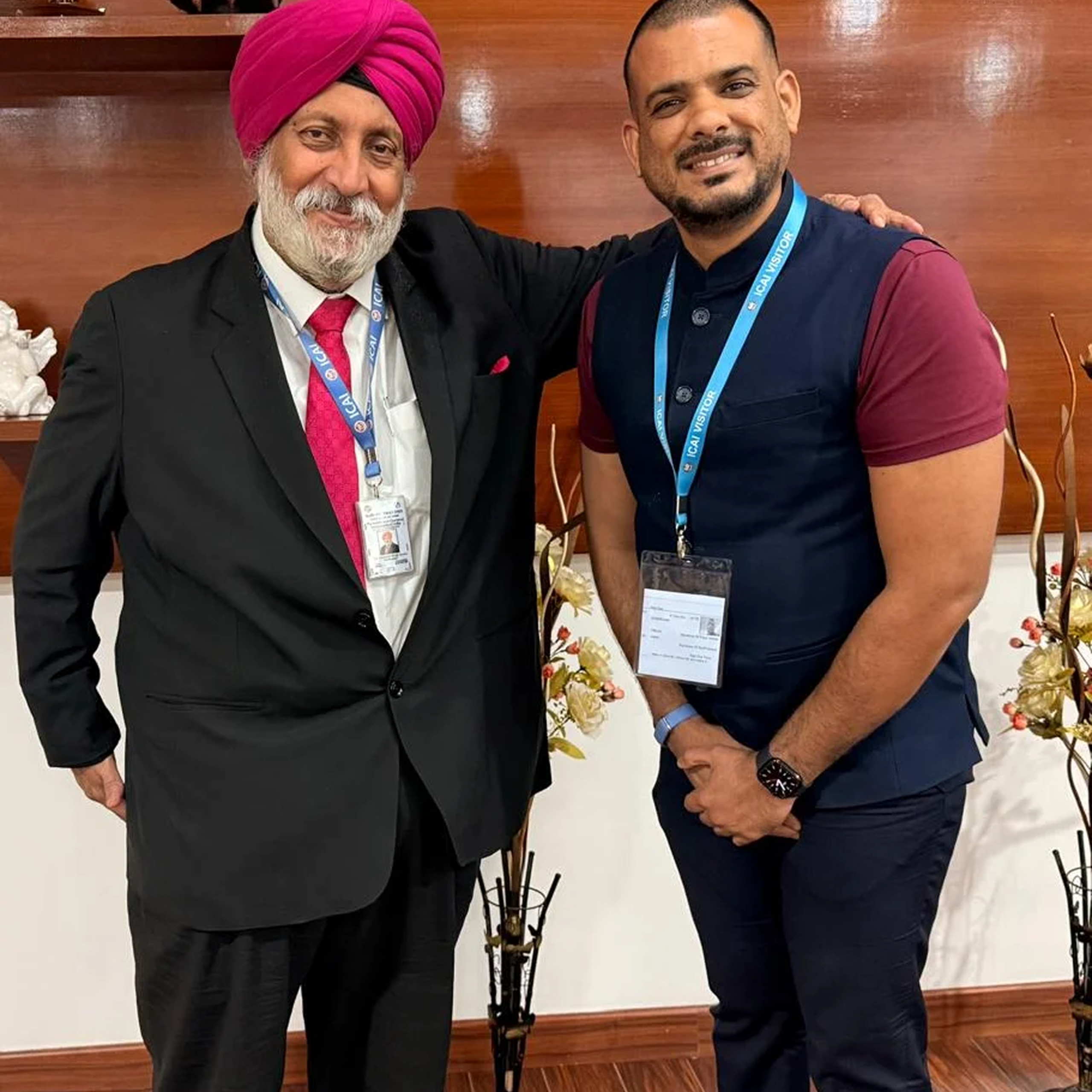

Built, Not Born
Built, Not Born: The CA Charanjot Singh Nanda Story
From the Coal Belt of Dhanbad to President, ICAI (2025–26).
His childhood playmates were snakes and scorpions in the coal belt of Dhanbad. He went on to lead the Institute of Chartered Accountants of India as its President for 2025–26 — after 9 election wins and 27 unbroken years of service to the CA fraternity.
That is the journey of CA Charanjot Singh Nanda, fondly known as Vicky bhai.
This is the story of what happened in between.
Part I — The Making
Snakes for Playmates
Born in 1968 in Yamunanagar, near Ambala, Haryana, he was barely six months old when his father shifted the family to Bihar, near the coal mines of what is now Jharkhand.
It was a different world. While other children played with bat and ball, his companions were the snakes and scorpions that inhabited the mining vicinity. What frightens most people became familiar to him. Perhaps that was his first lesson: fear is often just a lack of acquaintance.
His family was middle class — though, as he wryly notes, middle class in that era could well be considered upper class today. It was a home of enough, not excess. And perhaps that is precisely the soil in which conviction grows best.
An Entrance Exam That Made History
After a local school till the 2nd grade, his parents set their sights on De Nobili School, Dhanbad — a school that preferred to admit children of Bharat Coking Coal Limited employees. His father ran a logistics business with a few trucks. They didn’t qualify.
His mother refused to accept that.
A progressive woman, she stood before the principal and argued that education is an equal right — admission should be earned on merit, not reservation. Let the boy take an entrance examination, she said. If he qualifies, enrol him.
He qualified. He became the first student from a non-BCCL background to enter the school — and because of one mother’s conviction, that door stayed open for others after him.
The Father’s Quiet Hand
If his mother gave him the fire, his father gave him the foundation.
A man of deep faith, his father instilled in him the religious and ethical values that would become the bedrock of everything that followed — the compass that never wavered through nine elections and the highest office of the profession. He was a highly compassionate man, and his care extended beyond the family to every member of his staff, whom he looked after as his own. A philanthropist by nature, he gave quietly and gave often.
The son watched, and absorbed. Long before the boy learned accounting, he had learned the more important ledger — the one where compassion is the asset and ethics the currency. Integrity, he would discover, is not taught in classrooms. It is caught at home.
The Marksheet That Changed Everything
Till the 10th grade, he describes himself with one word: alhad — carefree. He played cricket even during exam days, without a trace of worry. In 1983, the result arrived: 57%.
His mother had expected 90%. The family, who believed in his brilliance, was disappointed. That discomfort became the turning point of his life.
He decided things would change. And they did — 2nd rank in pre-university. Merit position in every year of university at Mukand Lal National College, Yamunanagar. All India Rank 35 in CA Inter.
The carefree boy had found his discipline. He never let it go.
And alongside the discipline, something else was stirring. College gave him his first taste of standing for a cause — he was politically active from his student days, marching in the Mandal Commission protests. In the crucible of youth movements, he learned the two things that would define his entire career: how to organise people, and how to stand for something.
The Girl at the Farewell
Why CA? The answer is delightfully honest.
At his Class X farewell, the girl who spoke before him — known for her thorough research — announced she wanted to become a Chartered Accountant. He reasoned: if someone that well-informed has chosen this path, it must be the right one.
She never became a CA. He did — going on to start his practice in New Delhi in 1991.
Sometimes an angel sets your course and quietly exits the story.
400 Chapatis a Day
For his CA studies, he moved to Delhi with his mother and younger brother — a brother born in 1980, whom he raised with such care that he says, “He was more of a son to me than my younger brother.”
They stayed in his father’s uncle’s vacant residence. And then something remarkable happened. CA aspirants who couldn’t find living space in Delhi began taking shelter there. Three family members — and at times, 40 guests.
His mother cooked up to 400 chapatis a day, treating every guest as God. She sometimes even washed their clothes. When asked if the doors were open only to their own community, he smiled: a Gurudwara has four doors, so anyone may enter from any direction. The foundation of Harmandir Sahib itself was laid by the Sufi saint Mian Mir.
When neighbours falsely alleged they were charging rent, his mother answered with service, not argument. During heavy rains, a society member’s car sank in the mud — a crane would cost ₹3,000–4,000. She simply asked her guests to help. Forty hands pushed the car out.
The allegations stopped. The member returned with samosas and jalebis. And his mother seized the moment: send your children between 6 and 7 pm — these CA students will clear their doubts.
“It was the intent that made it possible, not the resources.”
Part II — The Journey
Nine Elections, One Inheritance
His mother’s nature of serving others became his compass. In 1997, he contested his first council election — and his fraternity, which knew him personally, voted him in unanimously.
He has not lost since.
Nine elections. Two Regional Council. Seven Central Council. Twenty-seven unbroken years of the members’ trust.
For those unfamiliar with the terrain: ICAI’s democracy runs deep. It begins at the branch level, rises through the Regional Councils, and culminates in the Central Council — 32 elected members and 8 nominated ones, from among whom the President and Vice President are chosen by a further vote of the Council itself. There is no prescribed ladder; a member may contest at any level. But to win, again and again, across three decades? That is not a ladder climbed. That is a relationship built.
“The Universe Conspires”
Here is the question everyone asks him, and rightly so: professional politics is a full-time job. Building a practice is a full-time job. How did he do both?
His answer is disarmingly simple:
“If you are willing to do a job with full shiddat — full passion — the entire universe conspires to support you.”
But listen closely, and you realise the universe had help. He knew his buffer time — those slivers of hours between commitments that most of us surrender to fatigue — and he guarded them ferociously, pouring them into his practice. Behind the philosophy stood a machine of discipline: meticulous time management, a son who is now a partner in the firm, fellow partners, and a dedicated team. Today, that practice spans Delhi, Chandigarh, Noida, and Ranchi.
The lesson is not that passion replaces planning. It is that passion funds it.
The Summit: A Presidency with Open Doors
In 2025–26, the journey reached its summit. The boy from the coal belt became the 73rd President of the world’s largest accounting body — steward of 1.4 million members and students.
The chapatis his mother rolled in that Delhi drawing room had travelled a long way.
Ask him what his vision was as President, and there is no grandiosity in the answer: to serve — the members, the students, the employees of the Institute — and to take the profession to unprecedented heights. To lift the brand of the Indian CA so high that the common man on the street knows exactly what the profession stands for, and takes full advantage of it.
But vision statements are cheap. What set his tenure apart was a door that never closed — perhaps an echo of a Gurudwara’s four doors, and of a home in Delhi that turned no one away. His office remained open to feedback and suggestions from every sphere. He made himself reachable — deliberately, structurally — so that a student in distress or a member with a grievance had a direct line. It gave him something no report or committee could: first-hand knowledge of the problems on the ground.
And from that ground-level view came changes that will outlast him:
Artificial Intelligence, mainstreamed. As head of the Committee on AI, he drove the AICA certification programme through its Level 1, 2, and 3 tiers — and today, 45,000 members stand AI-certified. In a profession accused of living in ledgers, that is nothing short of a cultural revolution.
Information Systems Audit Standards, approved. On 7 February 2026, the Council approved the Information Systems Audit Standards — a landmark he describes, without exaggeration, as a revolution in itself.
Forensic Accounting and Investigation Standards, delivered. In an era where financial fraud grows more sophisticated by the quarter, his tenure gave the profession its formal arsenal.
Ordinary Decisions, Extraordinary Outcomes
Some of the most telling moments of his tenure were bets that looked modest on paper:
WOFA 2025. His only hope was to avoid a loss. Instead, the event turned a profit while hosting 11,000 members — and in a testament to the goodwill the Institute commands, Ammy Virk performed without charging a penny. Gulshan Grover, likewise, took nothing.
AIS 2026. Profitable in monetary terms — but more importantly, in his own accounting, profitable in the value it delivered to every member who attended.
15 August 2025, Pahalgam. When others might have hesitated, he spent Independence Day in Pahalgam with family and the Institute’s community — and Omar Abdullah sahab himself came to the event, praising the fearlessness of the Institute.
Three ordinary decisions. Three extraordinary statements about what conviction looks like in practice. Fear, after all, is often just a lack of acquaintance — a lesson learned long ago among the snakes and scorpions of Dhanbad.
Part III — The Philosophy
The Mentor Under Thirty
Perhaps the most disarming story Nanda ji tells is about being schooled — at 58.
His early mentors were the giants of the Council: TN Manoharan, the past president, and other seniors who shaped his craft. That much is expected. But six months ago, in a conversation with a gentleman in the US, he was handed a perspective that upended everything:
“Mr. Nanda, you are wasting your life if you don’t have a mentor who is below thirty years of age.”
He took it seriously. He went looking for one.
You cannot link mentorship with age, he now says. The younger generation is more talented, more skilful — and they offer him what experience alone never can. From them he learns technology, yes, but also something subtler: a different way of looking at life itself. Because here is the trap of growing older — you begin to believe your decisions are correct. The young disagree with you. And in that disagreement lies balance.
Experience and talent, in dialogue. That is his operating system now.
The Fitrat of Manzilein
Every presidency has its storms — the difficult people, the impossible weeks, the moments when the weight of 1.4 million expectations presses down. What kept him going?
The poet in him answers before the administrator does:
“Dhundhoge ghar se to hi raste milenge, manzilon ki fitrat hai, khud chal kar nahi aati.”
Only if you step out and search will you find the roads — it is the nature of destinations that they do not walk to you.
And then he reaches for Swami Vivekananda:
“The day you are moving and find everything is smooth, be sure you are going on the wrong path.”
The challenges and obstacles you face, he says, are the sum total of your personality. A smooth road is not a blessing. It is a warning.
The Question of Regret
And then comes the question he has spent decades preparing to answer without knowing it — the one dressed as an accusation: You have given a considerable part of your life to this profession. Did you ever regret it?
He doesn’t flinch. He answers in verse.
“Main khuda ka naam lekar pee raha hoon ae dosto, zahar bhi isme hua to dawa ho jayegi.”
I drink taking the name of God, my friends — even if there is poison in it, it will turn to medicine.
Regret, he explains, is not a fact. It is a perspective. Work is his prayer — and for him, serving the Institute is the prayer. There was never any poison to begin with.
The son of a mother who treated every guest as God, and a father whose faith and philanthropy needed no audience, could hardly have answered any other way.
Nanda at 21, Nanda at 58
Ask him about his vision now, at 58, and he answers with two couplets that could serve as his autobiography:
“Sochne se kahan milte hain tamannaon ke shehar, chalne ki zid bhi zaroori hai manzil paane ke liye.”
The cities of your desires are never reached by thinking alone — the stubbornness to keep walking is essential to reach the destination.
“Ke apne hauslon ko khabar karte raho, zindagi manzil nahi, safar hai — chalte raho.”
Keep informing your courage — life is not a destination, it is a journey. Keep moving.
Nanda at 21 is the same as Nanda at 58, he says. Keep moving. Keep creating value.
But it is his closing couplet that lands hardest — a meditation on control that only a man who has contested nine elections could offer:
“Haath ki lakeerein bhi badi shaatir hoti hain, kambakht mutthi mein to hoti hain, par kaabu mein nahi hoti.”
The lines of the palm are cunning things — the wretches sit inside your fist, yet remain beyond your control.
So how does one control the outcome? His answer: you don’t. You control the input. Sacrifice everything you have — your resources, your effort — and give 100% of yourself. The outcome, he says, will take care of itself.
The Vision from the President’s Chair
Step back from the anecdotes, and his presidency resolves into five clear priorities — a blueprint for where he believes the profession must go:
AI & Digital Transformation. Not as a buzzword, but as certified capability — the AICA programme across Levels 1, 2, and 3, with 45,000 members already AI-certified, and a Committee on AI moving the profession from automation to high-order data analytics.
Future-Ready Chartered Accountants. New standards for a new era — Information Systems Audit Standards approved on 7 February 2026, and Forensic Accounting and Investigation Standards delivered in his tenure — equipping the CA to audit the digital economy, not just the ledger.
Global Recognition of the Profession. Lifting the brand of the Indian CA so high that the common man knows exactly what the profession stands for — and the world sees India as a Vishwa Guru in accounting, its CA’s signature a testimony of truth that billions can bank on.
Member-Centric Initiatives. An office with open doors, first-hand feedback from every sphere, and events like WOFA 2025 and AIS 2026 measured not just in monetary profit, but in the value delivered to every member who attended.
Capacity Building & Continuous Learning. From certification programmes to mentorship without age barriers — a profession that stays teachable at every level, because its President himself went looking for a mentor under thirty.
Five priorities. One thread running through them all: service — the inheritance from a Delhi drawing room where 400 chapatis were rolled a day.
The Advice He Leaves Behind
For the younger generation watching his journey — the article students burning midnight oil, the freshly minted CAs finding their feet — his counsel is stripped of all ornament:
Work with perseverance, honesty, and discipline. Speak with authority — but back that authority with values and knowledge so complete that no one can object to it.
The Lessons
Merit opens doors that privilege keeps shut.
Disappointment, faced honestly, is the best teacher.
Serve with intent — resources will follow.
Mentorship has no age — stay teachable at every summit.
Control your inputs; the outcome will take care of itself.
Ethics are caught at home before they are taught anywhere else.
What you inherit from your parents’ example can outlast any fortune.
His story is proof that leaders are not born into service. They are raised into it, humbled into it, and disciplined into it — from the snakes of Dhanbad to the summit of the profession, from 400 chapatis in a Delhi drawing room to 1.4 million members under his care.
Twenty-seven years of service. One signature. And a journey that, by his own definition, has no destination.
Zindagi manzil nahi, safar hai. Chalte raho.
Built, Not Born.
Was there one marksheet, one setback, or one person’s example that changed the direction of your life? Share your turning point below.
Based on an interaction with CA Charanjot Singh Nanda, 73rd President, ICAI (2025–26). Built, Not Born is an editorial series by Mustafa G. Daudi profiling professionals who constructed their success through grit, reinvention and quiet persistence. If you know someone whose story deserves to be told, reach out @mustafagdaudi@builtnotborn.co.in.